End of Days are so Yesterday


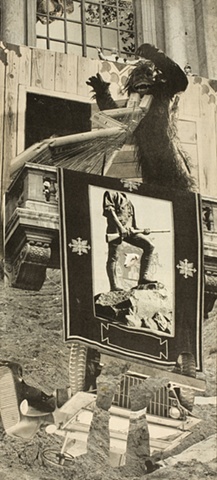


This body of work, created between 2007 and 2008, considers our relationship to the myth of the End Times. Rooted in the Judeo-Christian prophecy of Armageddon, the story of an approaching apocalypse has been retold for centuries without arriving. The work asks a simple question: End Times for whom? Against contemporary forms of catastrophe, inherited prophecies of doom begin to compete with crises entirely of our own making.
Environmental contamination, exhausted natural resources, economic exploitation, political oppression, and faith in systems of authority provide a contemporary backdrop to these works. Rather than illustrating any particular catastrophe, the collages absorb this atmosphere of anxiety, excess, and instability.
Familiar images are repeated, layered, and recombined until they become difficult to recognize. The resulting hyperreality is rhythmic, hypnotic, and nearly chaotic. Meaning becomes obscured by a frenzy of information that mirrors the insatiable appetite of consumer culture. Figures operate as impersonators and props within spaces that are simultaneously claustrophobic and disorienting. The works become portraits of dysfunction within landscapes barely able to contain their own contents.
For a 2008 solo exhibition at La Lutta Project Space, the original collages were enlarged as digital prints. The change in scale exposed the physical construction of the work: cuts, wrinkles, imperfections, and traces of the hand became increasingly visible, giving the images something of the quality of specimens under examination.